


-
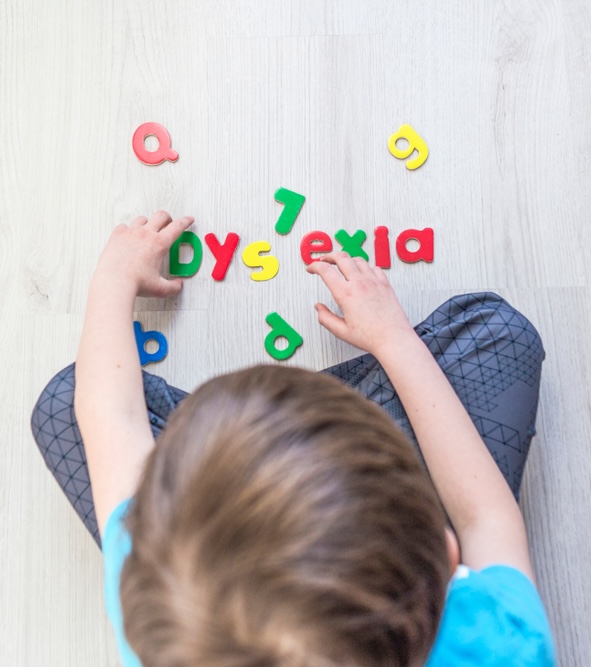
WHAT IS DYSLEXIA?
Your Guide To Navigating Dyslexia In SingaporeDyslexia, sometimes called a reading disorder, is a specific learning difference characterized by difficulties with learning to read or interpreting words and symbols, i.e. word recognition and spelling abilities.
This neurological difference has no correlation with intelligence; in fact, dyslexic individuals have average or above-average IQs. But left undiagnosed, dyslexia can cause your kiddo to be perceived as lazy or fall behind in school, lead to frustration in both child and parent, low self-esteem, and potentially a whole range of other mental health issues.
However, with support and/or intervention, those with dyslexia can thrive and unlock the full potential of their wonderful neurodivergent brains, maybe even lead exceptional lives – after all, dyslexia is linked to above-average creativity, and stronger causal reasoning and abstract, 4D thinking!
- Since dyslexia often co-occurs with ADHD and even ASD (or maybe more accurately the other way around), we invite you to also check out ADHD Resources And Support Groups In Singapore and Austism Resources And Support Groups In Singapore.
-

DYSLEXIA ASSESSMENT AND INTERVENTION CENTRES IN SINGAPORE
Dyslexia Support Programs In SingaporeFor many children, specialized programs, dedicated learning needs tutors, and education focused on proven methods are key to success. A formal diagnosis is often the first and most positive step, providing a roadmap for intervention and necessary school accommodations through institutions like the Ministry of Education (MOE).
Here is a list of trusted centres and organizations offering dyslexia assessments and intervention programs in Singapore:
- Dyslexia Association of Singapore (DAS)
- Website: www.das.org.sg
- Note: The DAS is the main local provider of services for children and adults with dyslexia in Singapore, offering comprehensive assessments, the Main Literacy Programme (MLP), and other educational services. It is the primary resource supported by the MOE for literacy support.
- Redwood Psychology
- Website: www.redwoodpsy.com
- The Gifted Lab
- Website: thegiftedlab.com
- Swords & Stationery
- Website: swordsandstationery.com
- Therapy Alliance
- Website: www.therapyalliance.com.sg
- Thomson Kids Specialised Learning
- Website: www.thomsonkids.com
- Mind.Space
- Website: www.mindspace.sg
- Extra Ordinary People
- Website: extraordinarypeople.sg
- Singapore Dyslexia Intervention Services
- Website: www.dyslexiaintervention.com.sg
- Singapore Brain Development Centre
- Website: brain.com.sg
- SACAC Counselling
- Website: www.sacac.sg
- Dyslexia Association of Singapore (DAS)
-

INCLUSIVE MAINSTREAM & INTERNATIONAL SCHOOLS IN SINGAPORE FOR DYSLEXIA SUPPORT
Inclusive Schools In Singapore For Kids With DyslexiaStudents with a formal diagnosis of dyslexia, typically supported by an official psychological report valid for three years, may be granted Access Arrangements in school. This can include essential support such as extra time on examinations and time-based assignments.
The schools listed below are often recommended for their strong Special Educational Needs (SEN) departments and experience in catering to the needs of neurodivergent students:
- The Winstedt School
- Website: winstedt.edu.sg
- Note: Known for its inclusive model, integrating occupational and speech therapy into the school day.
- Integrated International School (IIS)
- Website: iis.edu.sg
- Dover Court International School (DCIS)
- Website: www.dovercourt.edu.sg
- Note: Provides strong Special Educational Needs (SEN) support programs.
- Bright Path Preschool
- Website: www.brightpath.com.sg
- Singapore American School (SAS)
- Website: www.sas.edu.sg
- Note: Features extensive learning support services for students with differences.
- The GUILD International College
- Website: www.theguild.edu.sg
- Note: A specialized international college focusing on various learning needs.
- Wee Care
- Website: www.weecare.com.sg
- The Winstedt School
-

PARENT & COMMUNITY SUPPORT GROUPS FOR DYSLEXIA IN SINGAPORE
Community Support For Dyslexia In SingaporeFinding a community of people in a similar situation is invaluable for exchanging support, information, insight, and inspiration.
Here are the key parent and community support groups for dyslexia in Singapore:
- Dyslexia Association of Singapore (DAS) Parent Support Group
- Link: www.das.org.sg/get-involved/parents/102-join-the-parent-support-group.html
- Note: The official support arm of the DAS.
- Link: www.das.org.sg/get-involved/parents/102-join-the-parent-support-group.html
- Singapore Dyslexia Group (Facebook)
- Dyslexia Support Singapore (Facebook)
- SSNAP - Singapore Special Needs and Parents (Facebook)
- Link: https://www.facebook.com/groups/Singaporespecialneedsandparents
- Note: A broader community covering all special needs in Singapore.
- Link: https://www.facebook.com/groups/Singaporespecialneedsandparents
- Dyslexia Association of Singapore (DAS) Parent Support Group
-

ESSENTIAL DYSLEXIA RESOURCES AND INFORMATION
Keep Up To Date With The Latest InformationStaying informed is crucial. The field of neurodiversity and learning differences is constantly expanding, and these resources provide important information for parents and educators:
- National University Hospital (NUH)
- Resource: Dyslexia (Children)
- Note: Provides clinical health information about the condition.
- International Dyslexia Association
- Website: dyslexiaida.org
- Note: A key international body promoting effective teaching approaches.
- The Yale Center for Dyslexia and Creativity
- Resource: Resources for Parents
- Note: Offers research and guides highlighting the strengths associated with dyslexia.
- National University Hospital (NUH)
-

FINANCIAL ASSISTANCE AND MOE-SUBSIDISED PROGRAMMES
Government-Supported Pathways In SingaporeFor many Singaporean families, the cost of intervention is a major concern. Highlighting the government-supported pathways is essential for local relevance and search traffic targeting "affordability" or "subsidies."
- MOE-Subsidised Main Literacy Programme (MLP) at DAS:
- The Dyslexia Association of Singapore (DAS) Main Literacy Programme (MLP) is the only programme of its kind that is part-subsidised by the Ministry of Education (MOE).
- Eligibility for MOE Subsidy: Typically applies to Singapore Citizens attending MOE Mainstream Schools who have a formal diagnosis of dyslexia.
- Actionable Tip: Encourage parents to contact DAS directly to check their child's eligibility for the MOE-Aided MLP.
- School-based Dyslexia Remediation (SDR) Programme:
- This is a MOE-initiated programme conducted within mainstream primary schools for Primary 3 and Primary 4 students identified through systematic screening at the end of Primary 2.
- The SDR is a specialized literacy remediation programme delivered by trained English Language teachers.
- DAS Financial Assistance (Bursary):
- The DAS offers a bursary scheme for all their programmes, including those without a formal diagnosis, to ensure students who learn differently can access support. This is crucial for lower-income families.
- MOE-Subsidised Main Literacy Programme (MLP) at DAS:
-

ESSENTIAL ASSISTIVE TECHNOLOGY (AT) FOR DYSLEXIA IN SINGAPORE
Various Technology Employed To Help Dyslexic LearnersAssistive Technology is a game-changer for dyslexic learners, and explicitly mentioning the types of technology is a highly valuable resource for parents and educators.
- Key AT Tools to Mention:
- Text-to-Speech (TTS) Software: Allows students to listen to digital text being read aloud, helping with word decoding and comprehension (e.g., in the Singapore Student Learning Space - SLS).
- Speech-to-Text (STT) / Dictation: Enables students to vocalize their thoughts for writing assignments, bypassing handwriting or typing difficulties (dysgraphia).
- Organisational Tools & Mind Mapping Software (e.g., Popplet): Helps students structure their thoughts for composition and revision, directly addressing challenges with executive function.
- Scanning Pens (Pen Readers): Portable devices that can scan and read printed text aloud on the spot.
- MOE Support for AT: The MOE provides funding for various assistive devices for students with Special Educational Needs (SEN) in mainstream schools, though availability may vary. Parents should consult the school's Special Educational Needs (SEN) Officer or Teacher Trained in Special Needs (TT-SEN).
- Key AT Tools to Mention:
-

UNDERSTANDING CO-OCCURRING CONDITIONS
Educating Parents On Other Related Learning DifferencesDyslexia rarely occurs in isolation. Educating parents on other related learning differences encourages early, holistic assessment, leading to better outcomes and broader search term coverage (e.g., "dyslexia and ADHD Singapore").
- Common Co-occurring Conditions (SpLDs):
- Attention Deficit/Hyperactivity Disorder (ADHD): Very common alongside dyslexia, affecting focus and executive function.
- Dysgraphia: Specific difficulty with written expression, including handwriting, spelling, and organizing written thoughts.
- Dyscalculia: Specific difficulty with number concepts, mathematical reasoning, and mental calculation.
- Dyspraxia (Developmental Coordination Disorder - DCD): Affects motor coordination, sequencing, and organizational skills.
- Importance of a Holistic Assessment: Emphasise that a psychological assessment for dyslexia should ideally screen for these co-occurring conditions to ensure the intervention plan is comprehensive.
- Common Co-occurring Conditions (SpLDs):




 Recommends